- MUHAMMAD SHAHJAD S
- 0 Comments
- 606 Views
Introduction: The Invisible Backbone of Artificial Intelligence
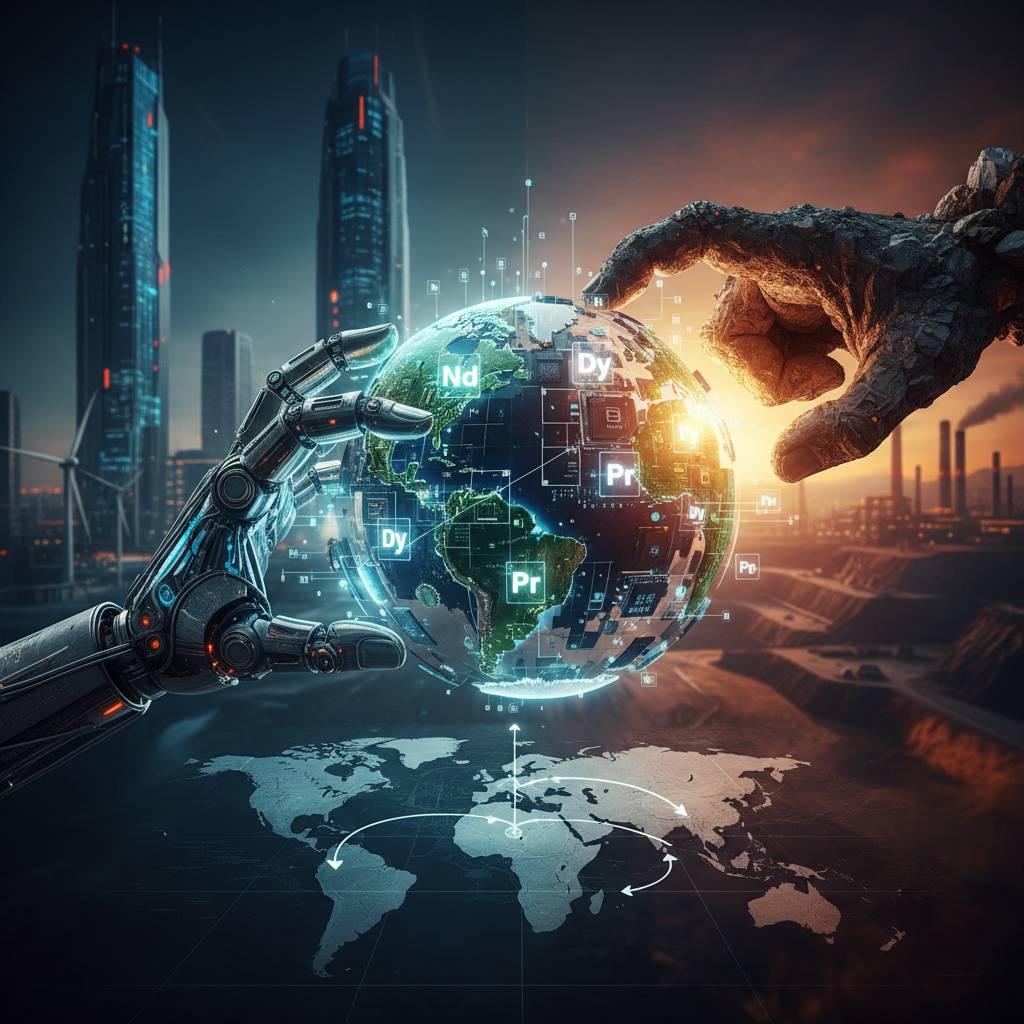
Artificial Intelligence is often described through software, algorithms, and data. But behind every AI model, data center, autonomous vehicle, and smart device lies a *physical reality: hardware. This hardware depends heavily on a small group of minerals known as *rare earth elements (REEs). As AI adoption accelerates, these elements are becoming the new oil—strategic, scarce, and politically sensitive.
What Are Rare Earth Elements?
Rare earth elements are a group of 17 metallic elements essential for high‑performance electronics. They are not truly “rare,” but they are difficult and expensive to extract and process.
Key rare earths used in AI hardware include:
- Neodymium & Praseodymium – powerful permanent magnets (GPUs, servers, EV motors)
- Dysprosium & Terbium – heat resistance for high‑performance computing
- Lanthanum & Cerium – camera lenses, sensors, and polishing of silicon wafers
Without these elements, modern AI hardware simply cannot scale.
AI hardware includes:
- GPUs and TPUs
- Data‑center servers
- Robotics and automation systems
- Edge devices (phones, cameras, IoT)
- Defense and surveillance systems
All of these rely on rare earth magnets, high‑precision components, and advanced semiconductors. As AI moves from software labs into real‑world infrastructure, demand for REEs is exploding.
Countries and the Coming Rare Earth Conflict
The global competition for rare earth elements is not just economic—it is geopolitical.
China: Present‑Day Control
- Controls the majority of global REE processing
- Dominates magnet manufacturing
- Uses rare earth supply as a strategic leverage in trade and diplomacy
United States & Europe: Strategic Catch‑Up
- Strong AI companies but weak mineral independence
- Heavy investments in alternative supply chains
- Focus on Greenland, Australia, Africa, and recycling
Australia: Trusted Supplier
- Major non‑China producer
- Politically stable and strategically aligned with the West
Greenland: Future Power Center
- Massive untapped reserves
- Strategic interest from global superpowers
- Environmental and political hurdles delay production
India & Africa: Latent Potential
- Large reserves but slow commercialization
- Infrastructure, policy, and technology gaps
From Trade Wars to Resource Wars
In the coming decade, competition may shift from:
“Who has the best AI?”
To:
Who controls the minerals that power AI?
Instead of direct military conflict, nations may use:
- Export restrictions
- Strategic partnerships
- Infrastructure investments
- Political influence over mineral‑rich regions
This silent struggle could redefine global power balances.
Ethical, Environmental, and Human Costs
Rare earth mining often comes with:
- Environmental damage
- Water contamination
- Displacement of communities
As demand increases, ethical sourcing and sustainable mining will become critical—not just morally, but politically.
A Spiritual Perspective: A Note from the Qur’an
Alongside technological and geopolitical shifts, many believers reflect on spiritual signs mentioned in the Qur’an.
Islamic scholars have long noted that the Qur’an reminds humanity that:
- Earth’s treasures are revealed by the will of Allah
- Wealth and resources emerge at appointed times as tests for mankind
There are interpretations and reflections suggesting that *hidden treasures of the earth—including gold—will become visible or accessible in later times, serving as both opportunity and trial. In this context, the modern rush for rare minerals and resources can be seen not only as economic competition, but also as a moral test of justice, restraint, and responsibility.
Technology may advance rapidly, but true success depends on how power and wealth are used.
Conclusion: Technology, Power, and Responsibility
AI is shaping the future, but rare earth elements are shaping AI. The nations that control these resources will influence:
- Global technology leadership
- Economic stability
- Defense capabilities
- Political power
As countries race for control, humanity faces a choice:
- Exploit without limits
- Or innovate with responsibility and ethical balance
The future of AI hardware is not just about faster machines—it is about how wisely humanity handles the treasures beneath its feet.