
- MUHAMMAD SHAHJAD S
- 0 Comments
- 1525 Views
An opinion piece on savings, financialisation, and community ownership
A new narrative around “invest wisely”
Across India, the message is getting louder: move your savings from traditional assets into market-linked
instruments. Large financial players, global asset managers, and domestic conglomerates are expanding
their presence in asset management, digital finance, and investment platforms. The pitch is familiar—
higher efficiency, liquidity, transparency, and growth.
This blog is not an accusation, but a concerned analysis of where this narrative could lead if
middle‑class Indians are not cautious.
Why gold and land matter to Indian households
For generations, Indian families have trusted gold and land as stores of value because:
- They are tangible and culturally rooted
- They protect against inflation and currency shocks
- They sit outside day‑to‑day market volatility
- They are usually held without intermediaries
These assets are not just financial instruments—they are social security for millions who do not fully trust institutions.
Financialisation: from ownership to volatility
When gold, land, or other real assets are increasingly:
- Fractionalised
- Tokenised
- Securitised
- Traded on platforms
…the nature of ownership changes.
What was once stable and personal can become volatile and market‑driven. Liquidity sounds attractive, but liquidity also means:
- Faster exits by large players
- Price discovery controlled by platforms
- Increased speculation
Over time, value can shift from households to institutions.
Tokenisation of land and assets: efficiency or control?
Tokenisation—turning real assets like land into digital tokens—is often promoted as the future. Potential benefits include:
- Easier transactions
- Reduced paperwork
- Fractional ownership
- Access to capital
But there are serious questions:
- Who controls the platform?
- Who sets the rules of trade?
- What happens during market stress?
- Can small holders truly influence decisions?
If land and core assets become just another tradeable token, ownership risks becoming abstract, while control becomes centralised.
The risk to the Indian middle class
The Indian middle class may face a quiet shift:
- Physical assets move into digital wrappers
- Households become “investors” instead of owners
- Long‑term assets turn into short‑term trades
- Decision‑making power concentrates with corporations and funds In such a system, even if assets are “owned,” control may not be.
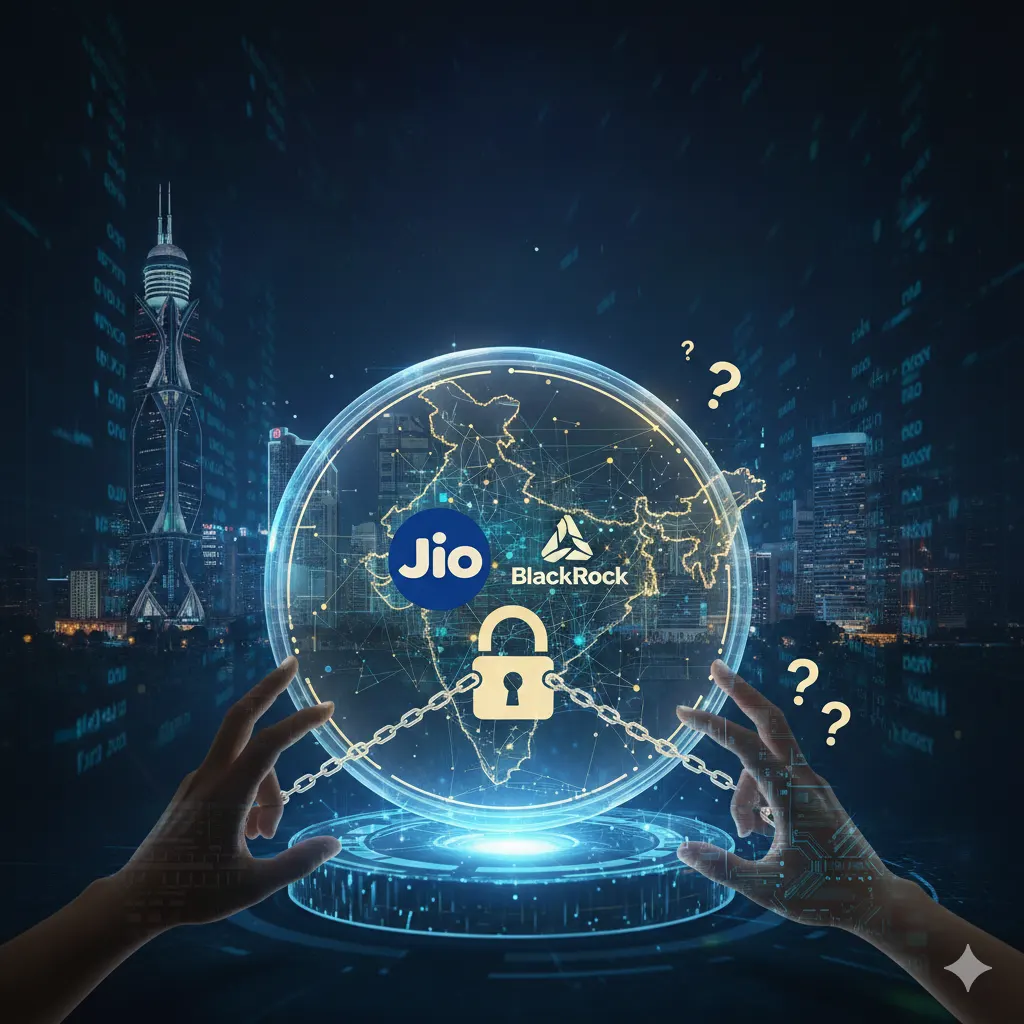
Jio & BlackRock: who they are and why they matter
Jio (Reliance ecosystem)
Jio is not just a telecom company—it is a full‑stack digital and financial infrastructure provider
under the Reliance group. Its strength comes from distribution and integration.
Key pillars of Jio’s corporate infrastructure:
- Mass digital reach: Hundreds of millions of users via telecom, apps, and devices
- Payments & fintech rails: Jio Payments, digital wallets, UPI integrations
- Data & platforms: Consumer behaviour data, cloud services, digital identity layers
- Regulatory alignment: Presence across telecom, finance, IFSC, leasing, and exchanges
This gives Jio the ability to educate, onboard, nudge, and retain users at population scale.
BlackRock (global asset management giant)
BlackRock is the world’s largest asset manager, managing assets across equities, debt, commodities, real estate, and alternatives.
Key pillars of BlackRock’s corporate infrastructure:
- Capital scale: Access to global institutional money
- Asset engineering: ETFs, structured products, fractional instruments
- Risk & analytics: Proprietary systems used by governments, banks, and funds
- Market influence: Ability to shape flows rather than just participate in them BlackRock’s edge is financialisation—turning almost any asset into an investable product.
BlackRock’s edge is financialisation—turning almost any asset into an investable product.
The combined infrastructure effect
When Jio and BlackRock operate in the same ecosystem, the combined capability looks like this:
- Jio provides users, data, distribution, and compliance reach
- BlackRock provides product design, capital pools, and asset volatility expertise
Together, they can:
- Convert traditional savings into market instruments
- Channel household capital into managed products
- Abstract physical ownership into digital exposure
This is infrastructure‑level power, not just business expansion.
A different idea: community‑based asset holding
An alternative worth serious discussion is community or cooperative ownership, where:
- Assets are pooled by individuals
- Governance stays local and transparent
- No single corporate entity controls liquidation
- Long‑term value is prioritised over short‑term volatility This model:
- Preserves collective bargaining power
- Reduces forced selling
- Keeps assets rooted in the community
- Aligns with India’s cooperative traditions
Ownership without excessive corporatisation may be safer for middle‑class stability.
This is not anti‑investment—it’s pro‑awareness
Markets, technology, and global capital are not inherently bad. But blind adoption without safeguards can be dangerous.
Middle‑class Indians should ask:
- Am I owning an asset—or just exposure to it?
- Who benefits most from liquidity?
- What happens if I don’t want to sell?
The road ahead
India stands at a crossroads:
- One path leads to hyper‑financialisation and platform‑controlled assets
- The other balances innovation with sovereign, community‑rooted ownership
The future should not convert every home, field, or ounce of gold into a trading chip.
Real prosperity comes from ownership with control—not just valuation on a screen.
Disclaimer: This article represents an opinion and forward‑looking concern. Readers should do their own research and seek professional advice before making financial decisions.